
TERMS OF REFERENCE (TOR)
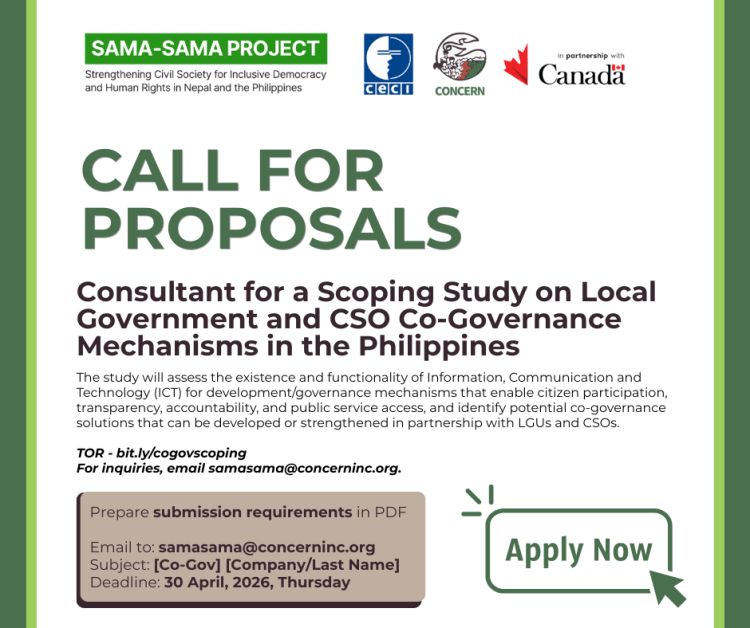
Consultant for a Scoping Study on Local Government and CSO Co-Governance Mechanisms in the Philippines
1. Background
The Sama-Sama Project (2025–2027) aims to strengthen civil society participation and improve collaboration between civil society organizations (CSOs) and local government units (LGUs) to promote inclusive governance, democratic participation, and human rights for women and marginalized groups (WMGs).
As part of the project’s first-year activities, participatory issue-mapping sessions with WMGs and capacity-building activities with CSOs have identified governance concerns related to transparency, accountability, public service delivery, and citizen participation in local decision-making. These findings highlight the need to examine existing governance mechanisms within LGUs and identify opportunities to strengthen collaboration between government and civil society.
To support this objective, the project will commission a Scoping Study on Local Government and CSO Co-Governance Mechanisms. The study will assess the existence and functionality of Information, Communication and Technology (ICT) for development/governance mechanisms that enable citizen participation, transparency, accountability, and public service access, and identify potential co-governance solutions that can be developed or strengthened in partnership with LGUs and CSOs.
For the purpose of this study, co-governance refers to structured mechanisms that enable collaboration between local governments and civil society organizations in policy development, service delivery, monitoring, and accountability processes using ICT tools.
The co-governance platform must strive to:
a. align with community needs while accounting for community contexts and capacities;
b. protect individual confidentiality and community data by integrating safety measures;
c. highlight community knowledge and promote community ownership;
d. facilitate the substantive participation and inclusion of WMGs; and
e. improve public service delivery by centering and integrating gender equality, human
rights, and inclusive governance principles.
2. Objective of the Assignment
The objective of the study is to identify and recommend potential co-governance mechanisms that strengthen collaboration between LGUs and civil society organizations in the selected project areas.
Specifically, the study aims to:
- Assess the existence and functionality of ICT for development/governance mechanisms related to transparency, accountability, public service delivery, and citizen participation in selected LGUs.
- Evaluate the accessibility and effectiveness of these mechanisms from the perspective of civil society organizations and WMGs.
- Analyze how these ICT mechanisms respond to governance issues raised by women and marginalized groups.
- Identify opportunities to develop or strengthen co-governance solutions that improve collaboration between LGUs and civil society.
- Map opportunities to develop or strengthen co-governance solutions that improve collaboration between LGUs and civil society.
- Identify LGU’s capacities and willingness to: a) establish a co-governance platform for monitoring, advocacy, public service delivery (PSD), gender-based violence (GBV) and discrimination; and b) strengthen PSD mechanisms through a co-governance platform and provision of training and protocols that utilize gender equality, human rights, and inclusive governance principles.
3. Geographic Scope
The study will be conducted in the following project areas:
Metro Cebu
- Cebu City
- Mandaue City
- Lapu-Lapu City
Eastern Samar
- Municipality of Taft
- Municipality of Dolores
4. Scope of Work
The consultant will conduct a scoping study to assess ICT for development/governance mechanisms that enable or support co-governance between LGUs and civil society.
The study will examine the following areas:
- Existing ICT infrastructure, tools and readiness for co-governance and public service delivery
- Functionalities, gaps, and opportunities of ICT mechanisms in LGUs geared towards
- Transparency mechanisms related to policies, financial disclosure and procurement
- Accountability mechanisms such as grievance and feedback systems
- Public service delivery systems and accessibility of services
- Participation mechanisms in policy-making and local decision-making processes
- Integration of gender equality, human rights, and inclusive governance principles
- Prospects and issues for engagement of CSOs with LGUs for co-governance mechanisms and platforms
5. Methodology
The consultant will employ a mixed-methods approach combining desk review, Key Informant Interviews (KIIs), and Focus Group Discussions (FGDs).
Desk Review
Review relevant LGU policies, governance frameworks, and available public information systems, as well as project documentation related to LGUs ICT infrastructure as a tool for transparency, accountability and accessibility for community and CSOs.
Key Informant Interviews
Conduct KIIs with LGU officials and relevant stakeholders to assess the existence, functionality, and accessibility of ICT for development/governance mechanisms. It will also assess the existing relationships between the LGU and CSOs and communities in relation to ICT governance and infrastructure.
Focus Group Discussions
Conduct FGDs with CSOs to validate LGU-reported mechanisms and assess awareness, usage, and satisfaction with existing governance mechanisms.
The consultant will present findings through a comparative analysis of LGU mechanisms and CSO experiences.
The study should integrate gender-sensitive and inclusive research approaches. Data collection methods should be accessible and culturally relevant for diverse participants, particularly those from CSOs and communities. All stages of the data gathering process require the creation of safe interview environments and the practice of active listening and use of gender-sensitive language. In data analysis and reporting, critical reflexivity and emphasis on the value of WMGs’ lived experience are necessary.
To effectively address disparities and inequalities, the study must prioritize solutions that directly benefit women and marginalized groups who are most disadvantaged by lack of substantive participation and influence in governance.
6. Deliverables
The consultant will produce the following outputs:
- Approved Inception Report
- Detailed methodology and work plan
- Data collection tools
- Draft Scoping Study Report
- Presentation of Initial Findings
- Final Scoping Study Report
7. Report Structure
The final report should include:
- Executive Summary (including conclusions and recommendations)
- Introduction
- Objectives of the Study
- Methodology
- Context Analysis
- Findings per LGU
- Comparative Analysis of LGU and CSO Responses
- Recommendations for Co-Governance Solutions (overall and/or per LGU)
- References
- Appendices (survey tools, interview list, participant list)
All raw data files and supporting materials must be uploaded to the project’s shared Google Drive.
8. Timeline
| Activity | Schedule |
| Call for Proposals | April 13 – 30, 2026 |
| Evaluation of Proposals | May 4 – 8, 2026 |
| Interviews and Selection | May 11 – 15, 2026 |
| Submission of Inception Report | May 22, 2026 |
| Data Gathering and Analysis | May 25 – July 20, 2026 |
| Presentation of Initial Findings | July 31, 2026 |
| Final Report Submission | August 7, 2026 |
9. Level of Effort
Total consultancy period: 40 working days
| Activity | Number of Days |
| Desk review and field data collection | 25 |
| Data analysis and report writing | 10 |
| Meetings and presentations | 5 |
10. Budget and Payment Schedule
Applicants must submit a detailed financial proposal including consultancy fees broken down by personnel, roles, number of days, and daily rates.
Meeting and travel expenses (including transportation, accommodation, and meals) will be reimbursed separately based on actual costs and approved implementation plans.
Payment Schedule
| Tranche | Payment |
| 1st | 20% upon approval of the inception report |
| 2nd | 60% upon submission of the draft scoping report |
| Final | 20% upon approval of the final report |
The total budget for the Consultancy (consultancy, meeting and travel expenses) must not exceed PhP 600,000.00.
11. Responsibilities of the Sama-Sama Project Team
The project team will:
- Provide relevant project information and documentation
- Facilitate coordination with LGUs and CSOs
- Provide introduction letters and identification where necessary
- Provide feedback on deliverables
- Ensure timely release of funds following approval of deliverables
12. Consultant Qualifications
The consultant (firm) should have:
- Demonstrated experience in governance research, ICT for governance/development, or related fields
- Strong knowledge of Philippine local governance systems
- Experience conducting policy or governance assessments
- Familiarity with civil society engagement and participatory governance
- Fluency in English and Filipino; knowledge of Cebuano/Bisaya is an advantage
13. Ethical Standards and Confidentiality
The consultant must adhere to professional ethical standards throughout the assignment. This includes maintaining confidentiality of interviewees and protecting any confidential or proprietary information obtained during the study.
All materials produced under this consultancy will remain the property of the project and may not be disclosed or used without prior written consent.
14. Submission Requirements
Applicants must submit the following:
- CV of the lead consultant
- Company or institutional profile
- Sample previous work related to ICT for development/governance or research
- Detailed financial proposal with itemized consultancy fees
- Names and contact information of three professional references
15. Submission Deadline
Proposals must be submitted no later than April 30, 2026, 11:59 PM.
For inquiries and submission of proposals, please contact:
Norika Ishikawa
Program Manager, Sama-Sama
Email: samasama@concerninc.org
ANNEX 1: DEFINITION OF TERMS
The Sama-Sama Project is guided by the following key principles or concepts:
GENDER EQUALITY
- State where all genders have equal rights, responsibilities, decision-making power, and equal access to resources (education, healthcare, employment, political participation, etc.)
- Recognizes that while people may be different, they should be equally treated and valued, and be able to attain their fullest potential
- Essential for achieving sustainable development, economic growth, social cohesion, and overall well-being for all members of society
HUMAN RIGHTS
- Fundamental rights and freedoms that belong and are innate to every person, regardless of status or background; these are not granted by any state
- Universally recognized moral principles or norms that establish standards of human behavior and are often protected by both national and international laws
- Encompass a broad range of civil, political, economic, social, and cultural rights
- Human rights-based approaches involve participation, accountability, non-discrimination, transparency, human dignity, empowerment, and rule of law
INCLUSION
- Practice of making sure that everyone, regardless of their background or identity, is included and has equal opportunities and access to resources to succeed
- Goes beyond diversity in groups and focuses on creating an environment where people’s voices are heard and everyone can meaningfully participate and contribute to their organizations or communities
INTERSECTIONALITY
- Concept that multiple social identities (such as race, gender, sexual orientation, ability, ethnicity, religion, and class) overlap to create unique experiences of discrimination and privilege for individuals; these intersecting identities cannot be understood in isolation, but rather as mutually constitutive forces that shape a person’s life in complex ways
- The theory extends beyond personal identity/ies to examine how interconnected systems of oppression (e.g. racism, sexism, classism, etc.) operate. Intersectionality can be used to analyze how social and cultural categories interact to create unique hierarchies and power structures.
INCLUSIVE GOVERNANCE
- Both a process and an outcome where all people, particularly those historically marginalized, can participate in, influence, and benefit from governance processes and decisions
ANNEX 2: PLATFORM OBJECTIVES
The Co-Governance Platform may be a single, multi-stakeholder governance mechanism that highlights and merges open governance, co-governance, participation, inclusion, gender equality and human rights.
1. Issue Identification and Monitoring
- Collect, map, and prioritize community concerns (PSD, DRR, GAD, political inclusion)
- Use gender equality, human rights, and inclusive governance issue-mapping framework to analyze gendered impacts and human rights concerns
2. Complaints and Feedback Mechanisms
- Provide accessible channels for submitting complaints or service gaps
- Track LGU responses and escalate unresolved issues
- Document and monitor patterns to inform advocacy and policy.
3. Women’s and Marginalized People’s (WMG’s) Political Participation
- Facilitate women’s involvement in barangay, municipal, and city decision-making
- Support women-led advocacy initiatives and leadership in LGU planning processes
- Promote civic engagement training, voter education, and election-related advocacy
- Ensure marginalized groups have voice in policy dialogues
- Integration of marginalized women’s knowledge and pedagogy
- Accessible and gender equality, human rights, inclusive governance aligned information and complaints mechanisms for PSD, GBV and discrimination
4. Co-Governance Engagement
- Enable collaboration between LGUs, CSOs, and WMGs
- Conduct joint assessment, planning sessions, consultations, and participatory budget and project reviews
- Validate and map monitoring outputs (scorecards, dashboards, service tracking)
- Provide simple and updated information on public services
- Establishment of complaint mechanisms on PSD, GBV and discrimination
- Institutionalize periodic multi-stakeholder forums for policy dialogue
5. Training and Capacity Building
Co-Gov training informed by gender equality, human rights, and inclusive governance for LGU staff, CSOs, and community volunteers covering:
- LGU and community co-creation of rules and ethics on maintaining and managing the platform
- Management of the digital platform using gender equality, human rights, and inclusive governance methodologies
- Mapping of issues, provision of information on PSD, GBV and discrimination
- Inclusive planning and implementation
- Monitoring and evaluation of public services
- Community engagement and co-governance practices and learning
6. Guiding Principles
All project activities will adhere to:
- Gender Equality – Address structural and systemic gender gaps
- Human Rights – Ensure protection and promotion of fundamental rights
- Inclusive Governance – Include women and marginalized groups meaningfully
- Participation – Ensure active involvement of stakeholders
- Accountability – Transparent and responsible governance
- Do No Harm – Safeguard participants from physical, social, or political risks
- Intersectionality – Consider overlapping forms of vulnerability
 Center for Emergency Aid, Rehabilitation and Development (CONCERN) Inc.